
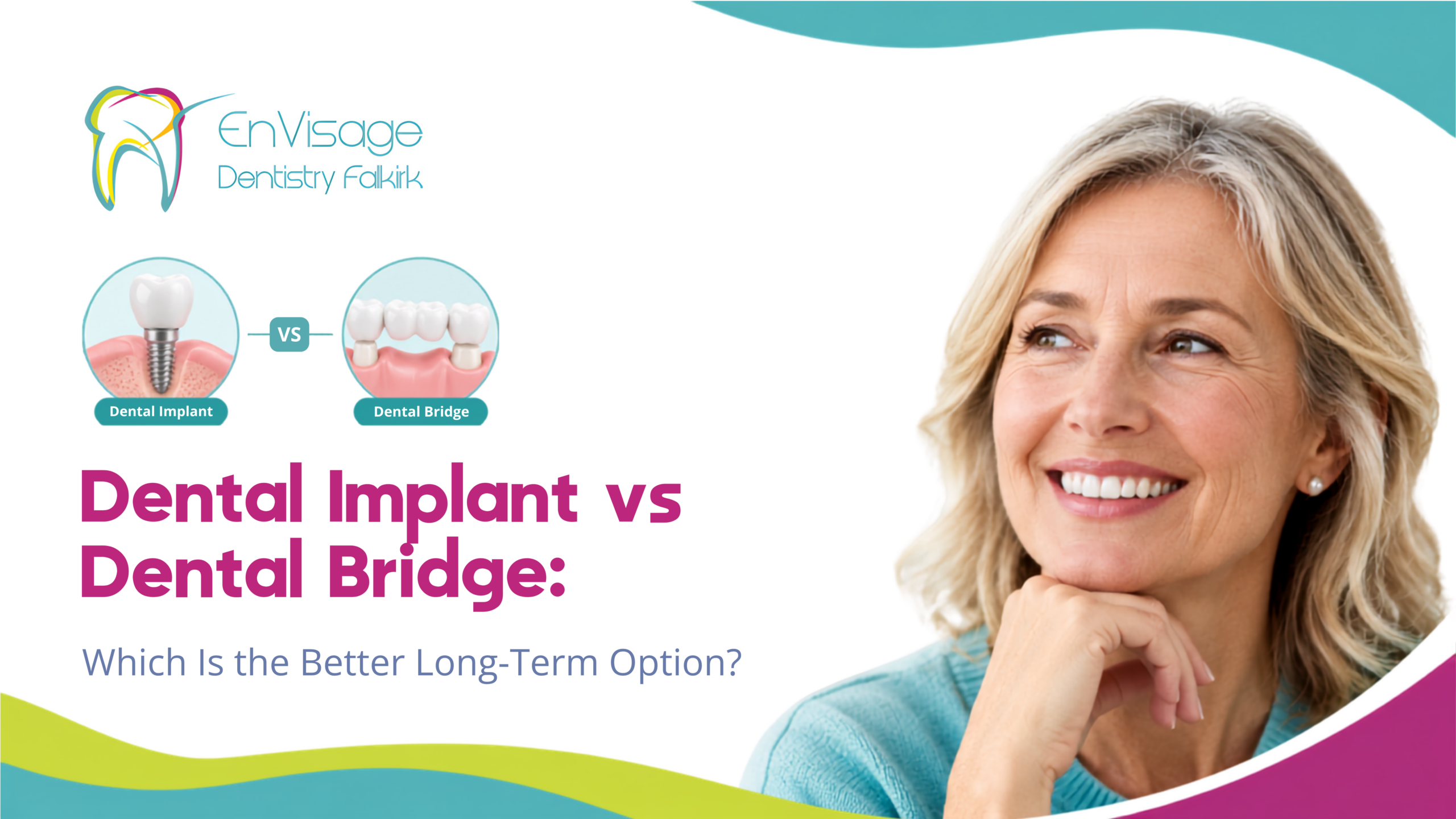
Losing a tooth can affect much more than the appearance of your smile. A missing tooth can make eating less comfortable, affect how you speak and leave neighbouring teeth with less support. If you are considering replacing a missing tooth, two of the most common fixed options are a dental implant and a dental bridge.
But which is better in the long term?
The answer depends on your oral health, the condition of your neighbouring teeth, the amount of bone available, your budget and how you want to approach treatment. There is no single solution that is right for everyone.
In this guide, we compare a dental implant vs dental bridge, including how each works, the benefits and drawbacks, treatment times, maintenance and cost considerations. If you are considering tooth replacement in Falkirk, understanding the differences can help you have a more informed conversation with your dentist.
Dental Implant vs Dental Bridge: What Is the Difference?
The biggest difference is how each treatment replaces the missing tooth.
A dental bridge replaces a missing tooth by using the teeth next to the gap for support. The replacement tooth, known as a pontic, sits between supporting crowns or attachments. Bridges are fixed in place rather than being removable like dentures.
A dental implant replaces the root as well as the visible part of the tooth. A small implant is placed into the jawbone and, once it has integrated with the bone, it can support a crown or other replacement restoration.
In simple terms:
- Dental bridge: replaces the visible tooth and uses neighbouring teeth for support.
- Dental implant: replaces the tooth root and supports a crown independently.
- Implant-supported bridge: several missing teeth can sometimes be replaced using implants as support.
Neither option should automatically be considered the “better” treatment. The right choice depends on your individual circumstances.
How Does a Dental Bridge Work?
A traditional dental bridge uses the teeth surrounding a gap to support a replacement tooth.
For example, if you have lost one tooth and the teeth either side of the gap are suitable, these teeth can be prepared to support the bridge. The artificial tooth sits between them, filling the space.
One advantage of a bridge is that it does not require implant surgery. Treatment can also generally be completed more quickly than an implant because there is no need to wait for an implant to integrate with the jawbone.
However, traditional bridges rely on neighbouring teeth for support. Depending on the type of bridge, this can mean altering otherwise healthy tooth structure.
A bridge may therefore be particularly worth discussing when:
- The neighbouring teeth already need crowns or substantial restorations.
- You want to avoid implant surgery.
- You would prefer a shorter treatment process.
- Your dentist determines that an implant is not appropriate.
- You are looking for a fixed replacement rather than a removable denture.
Your dentist will assess the health and strength of the supporting teeth before recommending a bridge.
How Does a Dental Implant Work?
A dental implant is designed to replace the root of a missing tooth.
During treatment, an implant is placed into the jawbone. The implant then needs time to integrate with the surrounding bone — a process known as osseointegration. Once healing has taken place, a crown can be attached to create the visible replacement tooth.
This means an implant does not depend on neighbouring teeth for support.
Dental implant treatment usually involves several stages, which may include an assessment, implant placement, a healing period and fitting the final crown. Some patients may also require additional treatment such as bone grafting if there is not enough suitable bone to support the implant.
At Envisage Dentistry Falkirk, dental implant treatment includes a free implant consultation, with finance options available to help spread the cost of treatment.
Dental Implant vs Dental Bridge: Which Lasts Longer?
When comparing a dental implant vs dental bridge, longevity is naturally one of the biggest considerations.
Dental implants are designed as a long-term tooth replacement and can remain functional for many years with appropriate care. However, an implant is not maintenance-free. The surrounding gums and tissues still need to be kept healthy, and regular dental examinations remain important.
Bridges can also provide long-term tooth replacement when properly planned and maintained. Their lifespan can be affected by factors such as oral hygiene, the health of the supporting teeth, bite forces and general dental health.
Rather than choosing a treatment based solely on an estimated lifespan, it is worth considering the long-term condition of the whole mouth.
For example, if a bridge places additional demands on neighbouring teeth, an implant may be worth considering where clinically suitable. Conversely, if the teeth surrounding the gap already require crowns, a bridge may provide a practical way to restore them while replacing the missing tooth.
Dental Implant vs Dental Bridge: Comparing the Benefits
|
Consideration |
Dental Implant |
Dental Bridge |
|
Replaces the tooth root |
Yes |
No |
|
Uses neighbouring teeth for support |
No |
Usually |
|
Requires surgery |
Yes |
No implant surgery |
|
Treatment time |
Usually longer |
Usually shorter |
|
Can replace a single missing tooth |
Yes |
Yes |
|
Helps maintain bone around the missing tooth |
Can help preserve the bone supporting the implant |
Does not replace the missing root |
|
Initial cost |
Usually higher |
Usually lower |
|
Maintenance |
Requires good oral hygiene and regular reviews |
Requires careful cleaning around and underneath the bridge |
|
Suitable for everyone |
No |
No |
This comparison is a starting point rather than a treatment recommendation. Your dentist will need to assess your teeth, gums, bite and overall oral health before deciding which option is appropriate.
What About the Cost?
Cost is an important part of the decision, particularly when comparing a dental implant with a bridge.
Dental implants generally have a higher initial cost because treatment involves surgical placement, the implant itself, the connecting components and the final crown. At Envisage Dentistry Falkirk, dental implants are currently listed from £2,880 per tooth, although the final cost depends on the treatment required.
A bridge may have a lower initial cost, but it is important to consider the entire treatment journey rather than comparing the price of one procedure with another.
You should also ask:
- What is included in the quoted price?
- Are scans or additional investigations required?
- Will I need any preparatory treatment?
- How long is the expected treatment process?
- What maintenance will be required?
- What happens if the restoration needs repairing or replacing?
At Envisage Dentistry Falkirk, finance options are available for eligible treatments over £250, including 6 months of interest-free finance and 24 months of low-APR finance, subject to the relevant terms and eligibility.
Is a Dental Implant More Natural Than a Bridge?
Both treatments can be designed to look natural.
A well-made bridge can be colour-matched and shaped to complement the surrounding teeth. Because it is fixed in place, it can restore appearance and function without the movement associated with removable dentures.
An implant-supported crown can also be designed to blend with your natural teeth. One of its key differences is that the implant is anchored in the jaw rather than relying on neighbouring teeth for support.
For many patients, the decision therefore comes down to more than appearance. Stability, oral health, treatment time, cost and the condition of the surrounding teeth all matter.
Does a Dental Implant Need a Scan?
Planning is an important part of implant treatment.
Depending on your individual case, your dentist may use dental imaging to assess the available bone and surrounding structures before implant placement. Three-dimensional imaging, such as a CBCT scan, can provide detailed information that helps with implant assessment and planning.
At an implant consultation, your dentist can explain which imaging is appropriate for your circumstances and why it is needed.
This is one reason why an initial assessment is so important. An implant should not simply be selected because it appears to be the longer-lasting option. The condition of the jawbone, gums, bite and remaining teeth all need to be considered first.
Which Is Better: Dental Implant or Bridge?
There is no universal winner.
A dental implant may be worth considering if:
- You want a fixed replacement that does not rely on neighbouring teeth.
- The surrounding teeth are healthy and you would prefer to leave them untouched.
- You have suitable bone and healthy gums, or any necessary preparatory treatment can be carried out.
- You are comfortable with a longer treatment process.
- You are looking for a long-term solution and understand the maintenance involved.
A dental bridge may be worth considering if:
- You want to replace a missing tooth without implant surgery.
- The neighbouring teeth are already heavily restored or require crowns.
- You prefer a potentially quicker treatment process.
- An implant is not suitable for you.
- Your dentist considers the surrounding teeth suitable for supporting a bridge.
There are also situations where neither option is immediately appropriate. Your dentist may recommend treating gum disease, improving oral hygiene, restoring other teeth or allowing an area to heal before deciding on tooth replacement.
What Should I Ask My Dentist Before Choosing?
If you are unsure which option is right for you, take the time to ask questions before making a decision.
Useful questions include:
- Are my neighbouring teeth healthy enough for a bridge?
If the supporting teeth are weak, heavily restored or affected by gum disease, this may influence whether a bridge is appropriate.
- Do I have enough bone for an implant?
Your dentist can assess the available bone and explain whether additional treatment might be required.
- How long will eachoptiontake?
A bridge and implant have very different treatment timelines. Understanding the stages can help you decide what fits your circumstances.
- What will the total cost be?
Ask for a clear breakdown of the complete treatment, including any scans, preparatory procedures and the final restoration.
- How will I need to look after it?
Both implants and bridges require good oral hygiene. Your dentist or hygienist can show you how to clean around the restoration effectively.
Why a Consultation Matters
Searching for “dental implant vs dental bridge” can help you understand your options, but online information cannot tell you which treatment is right for your mouth.
The condition of your remaining teeth, gums, jawbone, bite, medical history and personal priorities all influence the decision.
At Envisage Dentistry Falkirk, patients can discuss their options during a free implant consultation. The practice provides implant dentistry in the heart of Falkirk and can talk through the treatment process, expected costs and available finance options.
The aim should not be to choose the most expensive or most advanced option. It should be to find the treatment that makes sense for your oral health and long-term needs.
Dental Implant vs Dental Bridge: The Bottom Line
When considering a dental implant vs dental bridge, think beyond the initial appearance and price.
A bridge can offer a fixed, practical way to replace a missing tooth without implant surgery, particularly when the neighbouring teeth are suitable for supporting it.
An implant can provide an independent replacement for a missing tooth root and may be an attractive long-term option when there is sufficient bone and the surrounding oral tissues are healthy.
Ultimately, the better option is the one that is appropriate for your individual mouth, health and circumstances.
If you have a missing tooth and are considering your options, a consultation can help you understand what is possible before you commit to treatment.
Considering a Dental Implant in Falkirk?
If you have a missing tooth and are weighing up a bridge against an implant, speaking to a dentist is the best way to understand your options.
At Envisage Dentistry Falkirk, you can arrange a free implant consultation to discuss your individual needs, treatment options and costs. The practice is located at 58 Cow Wynd in Falkirk and offers finance options for eligible treatments.
Call 01324 624630 to arrange your consultation and take the first step towards replacing your missing tooth with a treatment plan tailored to you.
Dental Implant FAQs
Is an implant better than a bridge?
Not necessarily. An implant may offer advantages because it does not rely on neighbouring teeth, but a bridge can be a suitable and effective option in many circumstances. Your dentist should assess your individual oral health before recommending one.
Is a dental bridge cheaper than an implant?
A bridge will often have a lower initial cost than an implant, although the exact price depends on the type of restoration and the number of teeth involved. Implant treatment may involve additional stages and costs.
How long does a dental implant take?
Implant treatment generally takes longer than bridge treatment because the implant needs time to integrate with the jawbone before the final restoration is fitted. The exact timeline varies from patient to patient.
Can a dental bridge be replaced with an implant later?
In some circumstances, an implant may be considered after a bridge has been removed, but this depends on the condition of the teeth, gums and bone. Your dentist can advise whether this is possible in your particular case.